
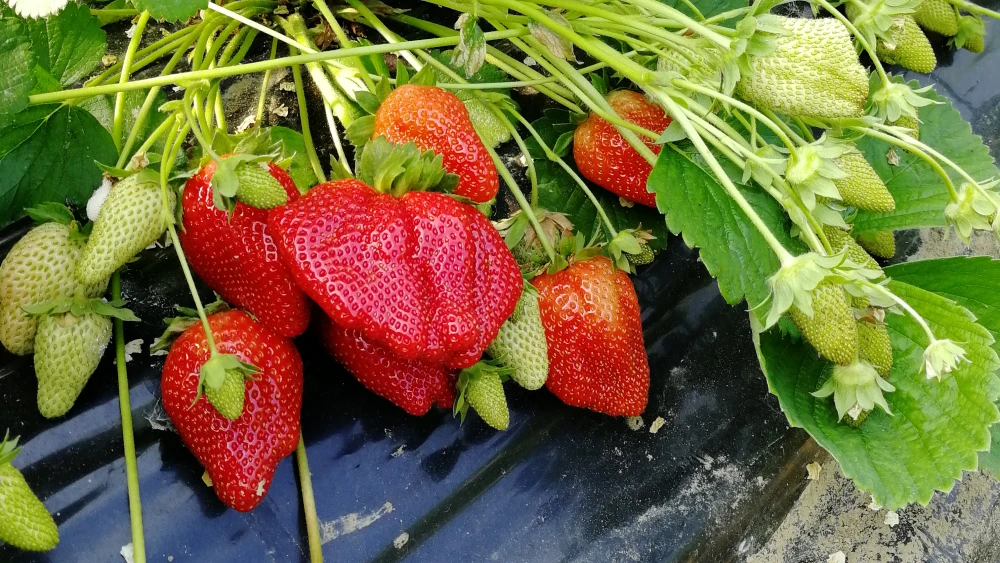
The main issues: when tissues cannot withstand stress
Globally, fruit and vegetable losses exceed 900 million tons per year. A significant share—estimated between 100 and 140 million tons—is attributable to physiological disorders and water–nutrient imbalances that compromise tissue integrity and the shelf life of produce (sources: FAO, UC Davis Postharvest Center, Acta Horticulturae).
During fruit development stages, particularly in the presence of water fluctuations, high temperature variations and nutritional imbalances, structural alterations may occur such as:
- discontinuities in cuticle deposition,
- instability of cell walls,
- loss of cellular turgor.
These phenomena make tissues more vulnerable to physiological and mechanical stress, promoting the onset of cracking, microcracking and handling damage.
From physiological imbalance to physiological disorder

Many fruit physiological disorders do not arise from a single sudden event, but from a set of imbalances that develop during growth. When water or nutritional fluctuations occur, fruit growth may not be accompanied by adequate adaptation of the outer tissues.
In particular, discontinuities in cuticle deposition can generate mechanical stress in the skin and promote the formation of micro-lesions, which progressively weaken tissue structure. Under these conditions, the following are frequently observed:
- calcium loss and reduced cohesion of cell walls;
- decreased tissue elasticity, linked to a less efficient organization of pectins;
- greater susceptibility to the spread of lesions following subsequent stresses.
At the leaf level as well, suboptimal stomatal regulation can exacerbate the plant’s water imbalance by increasing transpiration and contributing to a reduction in cell turgor. Taken together, these processes make fruits more vulnerable to tissue collapse and deterioration, with direct consequences on quality, storability, and marketable yield.

Why intervention is essential
Failure to act on these physiological mechanisms results in:
- reduced marketable yield,
- increased pre- and post-harvest waste,
- greater sensitivity to mechanical damage during harvesting, transport and storage,
- loss of uniformity and difficulty in meeting premium market standards.
In an increasingly demanding production context, stabilizing plant tissues becomes an essential condition to protect crop value.
FORTALIX™ and the stabilization of plant tissues

FORTALIX™ biostabilizing nutritional specialty, designed to support yields and preserve the quality of crops sensitive to physiological stress and water fluctuations.
The formulation, based on Silicon, Calcium and natural osmoprotectants, is developed according to Vegetal Tissues Stabilization (V.T.S.) technology, an integrated system that acts on the cuticle, cell wall and metabolism.
V.T.S. technology: triple synergistic action
Cuticle biostabilization
Silicon, delivered in a stable form with high affinity for the cuticle, helps improve its continuity and functionality, assisting in the regulation of water uptake and reducing the risk of microcracking.
Cellular biostabilization
Foliar calcium supply helps strengthen cell wall cohesion, promoting elasticity and mechanical resistance—key factors for more effective prevention of cracking and handling damage.
Metabolic optimization
Natural osmoprotectants support the regulation of plant turgor, mitigating internal pressure peaks and helping tissues better adapt to water fluctuations without losing structural integrity.
Concrete benefits in the field and post-harvest
Thanks to the stabilization of the cuticle, tissues and cellular turgor, FORTALIX™ helps to:
- reduce split fruit and microcracking,
- limit browning and post-harvest waste,
- improve production uniformity,
- increase the share of product meeting the highest quality standards,
- reduce weight loss during storage,
- improve resistance to mechanical handling.
The result is higher marketable yield, even under less favorable environmental conditions.

Application strategy: flexibility and prevention
FORTALIX™ fits easily into foliar nutrition programs thanks to its high miscibility with the most common formulations. General use guidelines call for applications every 7–10 days from fruit set to harvest, with the aim of progressively strengthening plant tissue stability, supporting fruit development during the stages most sensitive to physiological stress and helping preserve integrity and quality up to harvest.
In high-risk situations, such as ahead of rainfall events, FORTALIX™ can be used preventively, with targeted applications 5–6 hours before rain. In this case, the goal is to counteract the risk of cracking and microlesions, helping tissues cope with sudden water fluctuations.
FORTALIX™ is suitable for a wide range of sensitive crops, including strawberry and small fruits, cherry and other stone fruits, table and wine grapes, vegetable and greenhouse crops, potato, avocado and tropical fruits, where tissue stability is a key factor for marketable yield and storability.
Conclusions
In agriculture oriented toward quality and economic sustainability, protecting the integrity of plant tissues is a key strategy to increase real yields. FORTALIX™ represents an advanced nutritional solution that helps effectively address physiological disorders linked to water and nutritional stress, promoting improved crop quality and maintaining value throughout the supply chain.
The product can be used on a wide range of crops; it is particularly indicated for cultivations sensitive to water fluctuations and physiological disorders such as cracking, mechanical damage and rapid post-harvest deterioration.
FORTALIX™ is designed to be used as part of a continuous nutritional strategy aimed at strengthening plant tissue stability. In the presence of physiological stress, application can help support tissue balance, but it should not be considered a corrective or reparative intervention. The structural quality of fruits is the result of timely and prolonged nutrition that accompanies crop development during the most sensitive stages.
Yes, thanks to its high stability and miscibility, FORTALIX™ integrates into most existing technical programs.
No, FORTALIX™ does not replace proper agronomic practices or a balanced base nutrition. The product serves as a complementary support within integrated crop management, helping strengthen plant tissues in synergy with irrigation, nutrition and overall crop management.
Yes, as with any nutritional intervention, the effectiveness of FORTALIX™ depends on several factors, including climatic conditions, crop status, irrigation management and overall nutrition. For this reason, the product should always be included in a technical strategy adapted to the specific cultivation context.