
Fruit Crops
Fruit crops are a cornerstone of agriculture in terms of cultivated area and economic value. Species such as apple, pear, peach, cherry, and kiwifruit require increasingly precise management, made more complex by climate change and the demand for sustainable production. Fruit quality and yield stability depend on several factors, including water availability, soil fertility, and climatic conditions.
Proper management of nutrition, vegetative growth, phenological stages, and environmental stress is essential to obtain fruit of excellent size and quality while maintaining long-term profitability of the orchard.

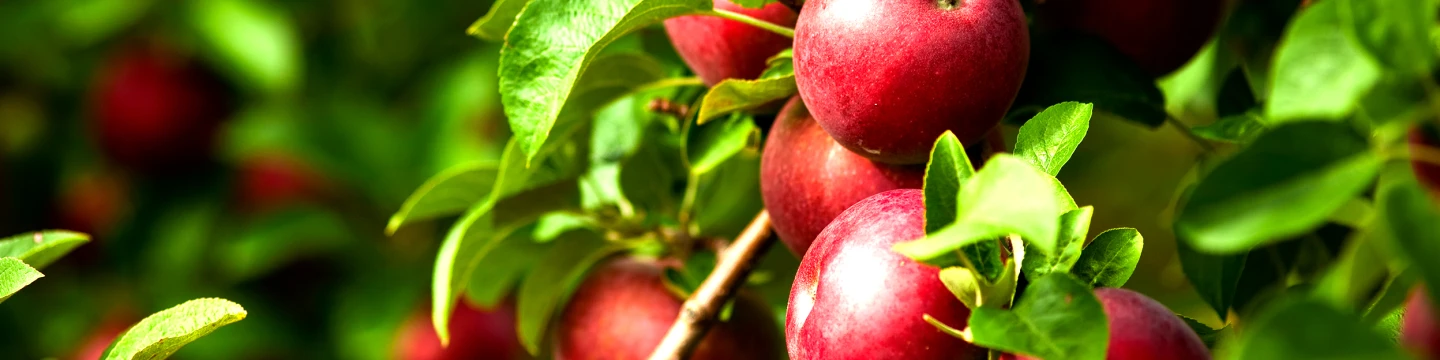
The apple tree (Malus domestica) is a Rosaceae species widely grown in temperate regions due to its adaptability and the high value of its fruits. It prefers cool climates and medium-textured, well-drained soils with a pH of 6.0–7.0. Balanced nutrition is required, particularly nitrogen, to avoid excessive vegetative growth. Proper canopy, irrigation, and fertility management ensures stable yields and high-quality fruit.

The apricot (Prunus armeniaca) is a fruit species belonging to the Rosaceae family, widely cultivated in temperate and warm-temperate regions thanks to its early fruiting. The tree flowers very early—often already at the end of winter—and is therefore exposed to the risk of late frosts, which may compromise production.Apricot is sensitive to excessive nitrogen, which can promote vegetative growth at the expense of fruiting; for this reason, balanced nutrition—properly distributed throughout the crop cycle—and the use of biostimulants during critical phases are essential.

The sweet cherry (Prunus avium) is a premium fruit species highly valued for the commercial and sensory quality of its drupes. Grown in temperate climates, it requires cold winters to satisfy its chilling requirement and dry, mild springs to ensure good flowering and fruit set. Flowering is early and very abundant, but it can be compromised by late frosts.Although some cultivars are self-fertile, cross-pollination remains essential to improve fruit set and achieve more abundant and uniform yields.The fruits, rich in sugars, minerals, and anthocyanins, require careful nutrition management, particularly regarding calcium, boron, and potassium—key elements for firmness, post-harvest performance, and aesthetic quality.

Kiwifruit (Actinidia deliciosa and Actinidia chinensis) is a high-value fruit crop native to the mountainous and humid regions of East Asia. Grown in temperate and humid climates, it requires a sufficient period of winter chilling to meet the chilling requirement and ensure uniform vegetative regrowth.The species is generally dioecious; therefore, cross-pollination is essential to achieve fertilization and subsequent fruit formation. Proper pollination and the thinning of lateral flowers are key practices to ensure production levels that meet commercial standards in both quality and quantity.

The peach tree (Prunus persica) is a Rosaceae species cultivated in temperate and Mediterranean areas, appreciated for fruit quality and early productivity. It prefers climates with cold winters, dry springs, and light, well-drained soils with pH 6.0–7.5. It requires balanced nutrition, with attention to calcium, boron, and micronutrients, to promote fruit size and quality. Proper pruning, thinning, and irrigation management ensure consistent yields and fruits that are healthy, uniform, and of high organoleptic and storage quality.

The pear tree (Pyrus communis) is a fruit species typical of temperate areas, appreciated for fruit quality and broad varietal diversity. It prefers well-drained soils with pH 6.0–7.0, avoiding waterlogging and calcareous soils. It flowers early and is sensitive to late frost. Balanced nutrition, with adequate calcium and boron supply, along with careful pruning and irrigation management, ensures consistent yields and high-quality fruit with good storability.

Persimmon (Diospyros kaki) is a fruit crop appreciated for its fruits rich in sugars, vitamins, and antioxidants. Grown in temperate climates, it requires moderately cold winters for good flower induction and stable spring conditions to support flowering and fruit set. Its abundant flowering may be parthenocarpic or fertilized depending on the variety.
Balanced nutrition—especially potassium, calcium, and microelements such as boron and zinc—together with careful management of irrigation, pruning, and fruit thinning promotes regular production and high-quality fruits with juicy flesh and good storability.
Balanced nutrition—especially potassium, calcium, and microelements such as boron and zinc—together with careful management of irrigation, pruning, and fruit thinning promotes regular production and high-quality fruits with juicy flesh and good storability.

The plum (Prunus domestica) is a fruit crop well adapted to temperate climates, appreciated for its varietal diversity and fruit quality. It requires cold winters to meet its chilling requirement and mild springs for good flowering and fruit set; its shallow root system is sensitive to waterlogging. Flowering is early and abundant and may be damaged by frost. Cross-pollination, even in self-fertile cultivars, improves fruit set. The fruits, rich in sugars and antioxidants, require balanced nutrition with particular attention to calcium, potassium, and micronutrients.